

Support Us
Menu
Menu
If you, or someone you know, have experienced or taken part in hostility against or between faith communities or individuals in Solihull or Glasgow and would like to talk to someone about whether Restorative Justice is for you, please get in touch.
If you, or someone you know, have experienced or taken part in hostility against or between faith communities or individuals in Solihull or Glasgow and would like to talk to someone about whether Restorative Justice is for you, please get in touch.
Our trained Community Facilitators can provide non-judgmental support to people with a range of experiences including:
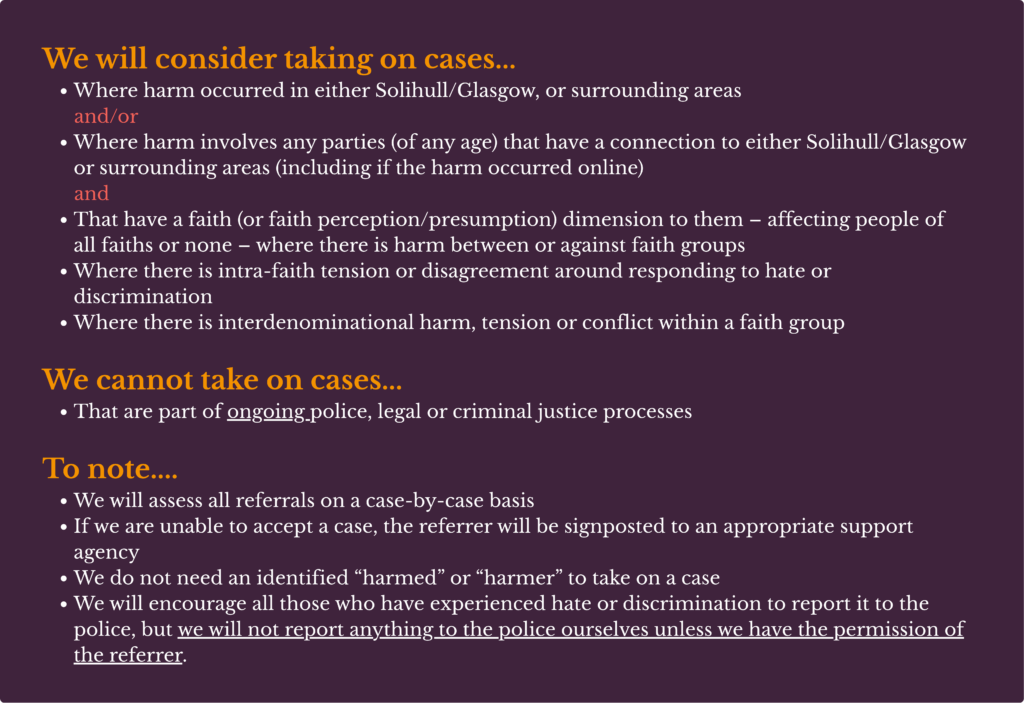
The criteria on how we decide to take on cases is below – if you are unsure if your experience meets the criteria, we’d be happy to talk it through with you.
Who will handle my case? Contacting Luke or Jaishree (above) is the first step; they will decide if we can take your case on. If we can, you will be assigned two of our trained Community Facilitators, who will work on your case as a pair. They will be based in either Solihull or Glasgow and are all from a variety of local faith communities and backgrounds. All Community Facilitators are supported and supervised by a RJ Practitioner, Anika Cosgrove from our partner organisation Why me?.
What is RJ? Restorative Justice is a transformative way to repair harm. It empowers everyone affected to reflect on the impact of the harm, communicate openly, and move forwards. It encompasses many different practices from one-to-one conversations with a trained practitioner to bringing people who have caused harm together with those they have harmed. Whatever form it takes, RJ has connection and healing at its root. Why me? has a whole page on “What is RJ?” including interesting videos which explain it more fully.
I was the one responsible for the harm – can I still get in touch? Yes. We know it can be hard to admit you’ve hurt others and RJ can help hold you accountable, make amends and heal harm. We cannot guarantee that whoever you have harmed will want to engage, but please do still talk to us about your case even if you are not sure.
Why are you only looking at faith-based hostility? We are funded by The National Lottery to bring Interfaith practices to Restorative Justice in Solihull and Glasgow. We therefore have a focus on faith-based harm against or between faith communities. This doesn’t mean other associated harms are not relevant or will be ignored – race, gender, ability, class and sexuality may all form a part of the harm that was caused, however for us to be able to work on a case it must have a religious (or perceived religious) dimension. Please contact us if you are not sure if your case fits these criteria and we would be happy to discuss it with you.
I don’t know who it was that I experienced hostility from – can I still get in touch? Yes, even if you don’t know who it was, please do talk to us about your case – there may be ways we can help you reflect on your experience and move on from the harm even without involving the other person. Many people think that RJ is only meeting the person who caused you harm, but in reality, there are lots of other ways we can help without this face-to-face process.
Why do you use the terms “harm” and “harmer”? In RJ, the words ‘offender’, ‘perpetrator’, and ‘victim’ are not used. Instead individuals are referred to as ‘harmer’ and ‘harmed’, or ‘person harmed’ accordingly. There is lots of research in to why this is a helpful approach – the main reason is that by not defining an individual as ‘good’ or ‘bad’ according to their actions (even if there actions were bad), we can instead focus on repairing the harm that has been caused for all parties involved.
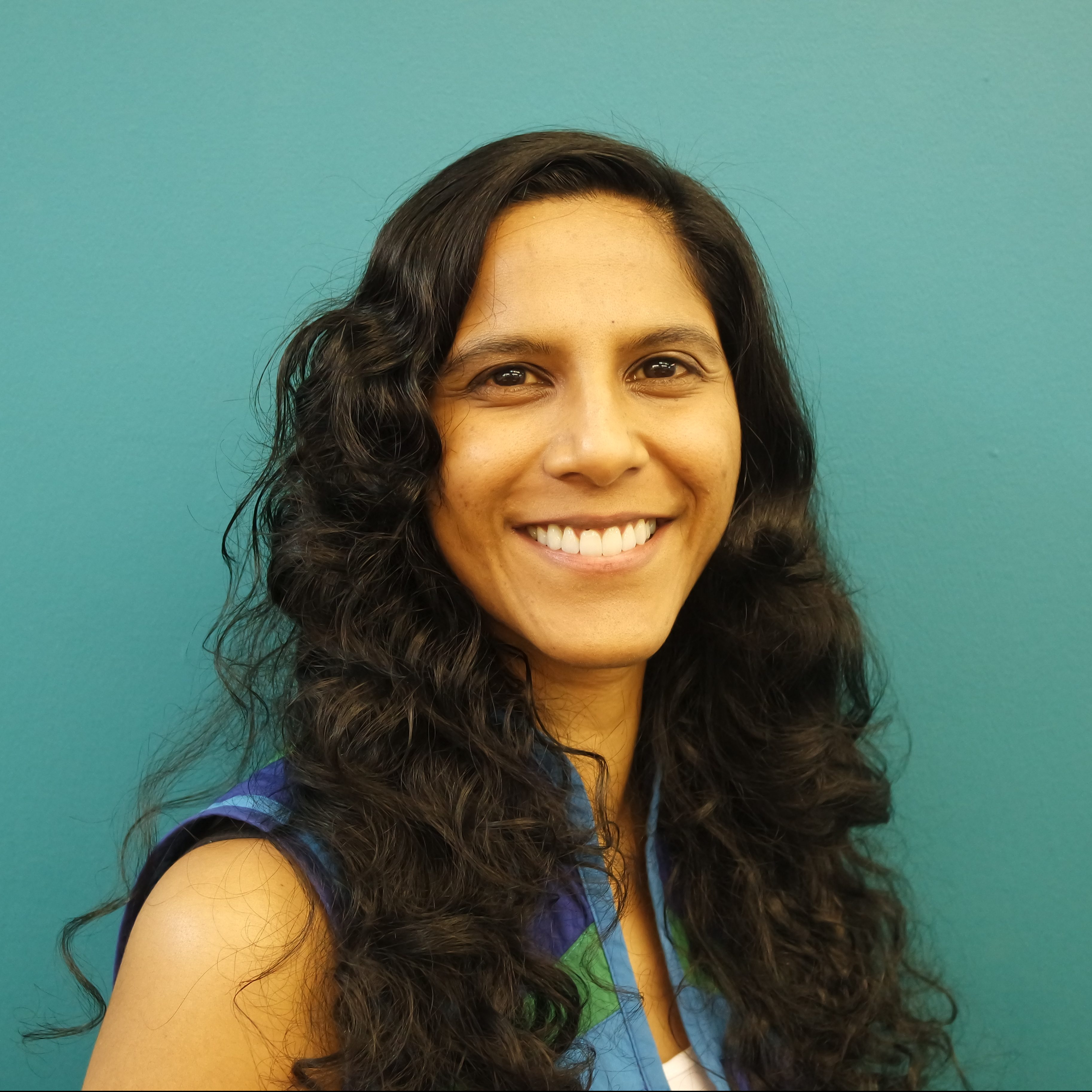
Jaishree Patel
jaishree.patel@faithbeliefforum.org